
Literal equations are frequently practiced using worksheets, like the ‘1.6.2 Literal Equation Practice.pdf’ found on Course Hero, designed for Algebra 1 students.
These PDF resources offer targeted practice, often including solving for variables in formulas, enhancing understanding and skill development.
What are Literal Equations?
Literal equations are equations that contain multiple variables, rather than just one unknown value. Unlike typical algebraic equations solved for a numerical answer, these equations are solved for one variable in terms of the others.
Worksheets, such as the ‘1.6.2 Literal Equation Practice.pdf’ available on platforms like Course Hero, are instrumental in grasping this concept. These PDF documents present equations where students must isolate a specific variable – often denoted by letters like T, W, x, y, or b – using algebraic manipulation.
The practice focuses on applying inverse operations and maintaining equation balance, skills honed through repeated exercises found within these worksheets. Solving these equations isn’t about finding a number; it’s about rewriting the formula to express one variable as a function of the rest.
Why are Literal Equations Important?
Literal equations are crucial because they form the foundation for understanding formulas used across various disciplines, including physics, engineering, and geometry. Mastering these equations allows for flexible problem-solving, enabling you to adapt formulas to specific scenarios.
Resources like the ‘1.6.2 Literal Equation Practice.pdf’ worksheet, readily available on Course Hero, provide essential practice in manipulating these formulas. These PDF exercises build a strong algebraic foundation, preparing students for more complex applications.
The ability to rearrange formulas is not merely an algebraic skill; it’s a critical thinking skill. It fosters a deeper understanding of relationships between variables and empowers you to analyze and solve real-world problems effectively, going beyond simple numerical solutions.

Understanding the Basics
Literal equation worksheets, such as those found on Course Hero, emphasize identifying variables within formulas and practicing algebraic manipulation skills.
Identifying Variables
Literal equations worksheets, like the ‘Algebra 1 Section 8 Literal Equations WS 3’ example, heavily focus on the crucial skill of identifying variables. Students must discern which symbols represent unknown quantities that need to be isolated and solved for.
These worksheets often present equations used in various contexts – geometry (area, perimeter), physics, or general algebraic relationships. Recognizing the variables is the first step towards successfully manipulating the equation;
For instance, in P = IRT, students need to identify P, I, R, and T as variables. Worksheets provide ample practice in recognizing these, preparing students for more complex problem-solving scenarios. Mastering this skill is foundational for tackling literal equation challenges.
Coefficients and Constants in Literal Equations
Literal equations worksheet PDFs, such as those available on Course Hero and similar platforms, emphasize understanding the roles of coefficients and constants. Coefficients – the numerical factors multiplying variables – are key to manipulating equations effectively.
Worksheets often present equations like 2A = LW, where ‘2’ is a coefficient. Students learn to treat coefficients as constants when isolating variables, applying inverse operations carefully. Constants, the fixed numerical values, remain unchanged during the solving process.
Recognizing these distinctions is vital. Worksheets provide practice in correctly applying operations to both sides of the equation, maintaining balance while accounting for coefficients and constants. This builds a solid foundation for more advanced algebraic manipulations.

Solving Literal Equations: A Step-by-Step Guide
Literal equations worksheet PDFs guide students through isolating variables using inverse operations, mirroring the process for numerical solutions, fostering algebraic fluency.
Isolating the Target Variable
Literal equations worksheet PDFs heavily emphasize the crucial skill of isolating the desired variable. These worksheets, such as the ‘Algebra 1 Section 8 Literal Equations WS 3’, present equations where students must manipulate terms to get the specified variable alone on one side.
This involves strategically applying inverse operations – addition/subtraction, multiplication/division – to both sides of the equation, maintaining balance. The worksheets often feature variables in various positions, requiring students to undo multiple operations.
For example, solving ‘P = IRT’ for ‘T’ necessitates dividing both sides by ‘IR’. Practice with these PDF resources builds confidence in recognizing and executing these algebraic maneuvers, a foundational skill for more complex problem-solving.
Using Inverse Operations
Literal equations worksheet PDFs consistently reinforce the application of inverse operations as the primary method for solving. Documents like ‘1.6.2 Literal Equation Practice.pdf’ and ‘Algebra 1 Section 8 Literal Equations WS 3’ present problems designed to test this understanding.
Students learn to ‘undo’ operations performed on the target variable. If a variable is multiplied, division is used; if added, subtraction is applied, and so on. Maintaining equality is paramount – whatever operation is done to one side must be mirrored on the other.
These PDF exercises often include equations with multiple steps, demanding sequential application of inverse operations. Mastery of this technique, honed through worksheet practice, is essential for successfully manipulating and solving literal equations.
Maintaining Equation Balance
Literal equations worksheet PDFs, such as those available on Course Hero (‘1.6.2 Literal Equation Practice.pdf’) and worksheets like ‘Algebra 1 Section 8 Literal Equations WS 3’, heavily emphasize the critical principle of maintaining equation balance.
Any operation performed to isolate the target variable must be applied identically to both sides of the equation. This ensures the equality remains valid throughout the solving process. Worksheets often present equations requiring multiple steps, testing a student’s consistent application of this rule.
Understanding this concept is fundamental; altering one side without a corresponding change to the other invalidates the equation. These PDF resources provide ample practice to solidify this core algebraic principle.
Common Types of Literal Equations
Literal equations worksheet PDFs, like those from Algebra 1 resources, commonly feature solving for variables in geometric formulas and multi-step algebraic expressions.
Solving for a Variable in Formulas (e.g., Area, Perimeter)
Literal equations worksheet PDFs frequently emphasize solving for a specific variable within common formulas. For instance, students might encounter problems requiring them to rearrange the area of a rectangle formula, A = LW, to solve for L or W.
Similarly, perimeter formulas (e.g., P = 2L + 2W) are often used to practice isolating a single dimension given the perimeter and the other dimension.
These worksheets, such as the ‘Algebra 1 Section 8 Literal Equations WS 3’, provide targeted practice in applying inverse operations to isolate the desired variable, reinforcing the concept that formulas can be manipulated to reveal relationships between different quantities.
This skill is crucial for applying mathematical concepts to real-world scenarios.
Solving for a Variable with Multiple Operations
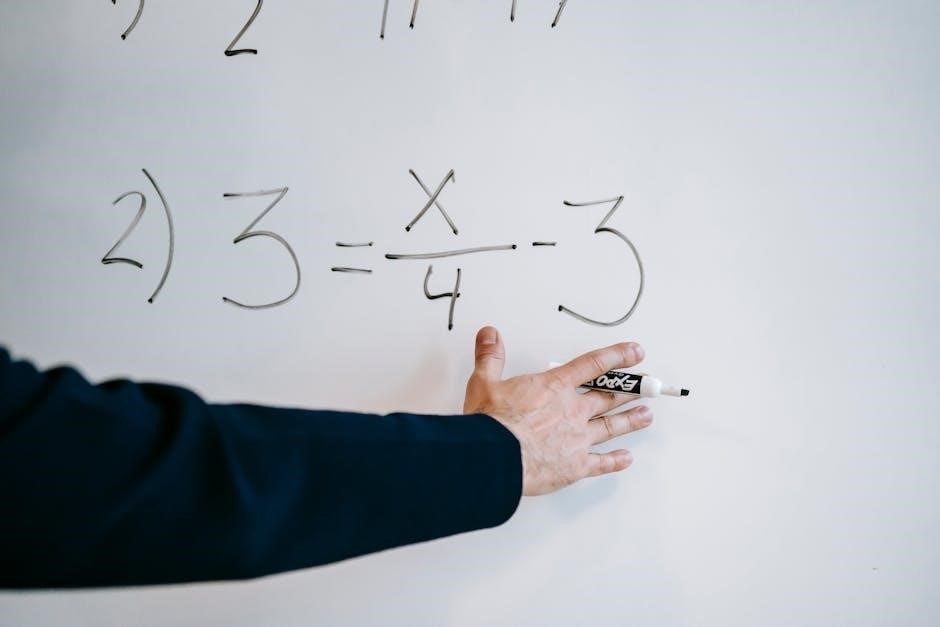
Literal equations worksheet PDFs often present problems requiring students to undo several operations to isolate the target variable. These exercises build upon the foundational skills of using inverse operations, but demand a more strategic approach.
For example, a worksheet might include equations like 5x + 3y = 10, requiring students to first subtract 3y from both sides, then divide by 5 to solve for x.
Resources like those found on Course Hero, such as ‘1.6.2 Literal Equation Practice.pdf’, provide ample practice with these multi-step scenarios, emphasizing careful order of operations and equation balancing.
Mastering this skill is essential for tackling more complex algebraic manipulations.
Solving Equations with Fractions
Literal equations worksheet PDFs frequently incorporate fractions to increase the complexity of solving for a specific variable. These problems often require students to utilize techniques like multiplying both sides of the equation by the least common denominator (LCD) to eliminate the fractions.

Worksheets, such as examples available through resources like Course Hero’s ‘1.6.2 Literal Equation Practice.pdf’, present equations like a/b + c/d = e, challenging students to isolate ‘a’.
Successfully navigating these equations demands a strong understanding of fraction operations and careful attention to maintaining equation balance.
Practice with these types of problems builds confidence and proficiency in algebraic manipulation.

Practice Problems & Resources
Literal equations worksheet PDFs, like ‘1.6.2 Literal Equation Practice.pdf’ on Course Hero, provide ample practice. Worksheets focus on solving for indicated variables.
Literal Equations Worksheet PDF Examples
Numerous literal equations worksheet PDF examples are readily available online, catering to various skill levels. Course Hero hosts resources like ‘1.6.2 Literal Equation Practice.pdf’, specifically designed for Algebra 1 students in Unit 1B, Section 1.6.
These worksheets typically present a series of equations where students are tasked with solving for a specific variable. For instance, problems might involve isolating ‘T’ in the equation P = IRT, or solving for ‘W’ in A = LW.
Other examples include solving for ‘x’ in 5/6y = x, or ‘y’ in 2/3(8x) = y. Worksheets often include equations with multiple operations and those requiring distribution of negative signs, building a strong foundation in algebraic manipulation. These PDFs are invaluable tools for reinforcing concepts.
Course Hero Resources for Literal Equations
Course Hero provides a valuable collection of resources dedicated to literal equations, prominently featuring PDF worksheets for practice. The ‘1.6.2 Literal Equation Practice.pdf’ document, sourced from Hilliard Bradley High School’s Algebra 1 curriculum (Unit 1B, Section 1.6), is a prime example.
This resource focuses on achieving Learning Target 11: the ability to solve a literal equation for any designated variable. Students can access and download these materials to supplement classroom learning and independent study.
Beyond individual worksheets, Course Hero may also host related materials like answer keys, step-by-step solutions, and potentially, more comprehensive study guides. These resources are designed to aid students in mastering the techniques required to manipulate and solve literal equations effectively.
Worksheet: Solving for T, W, x, y, and b
Many literal equations worksheets, available in PDF format, concentrate on isolating specific variables. A common exercise involves solving for variables like T, W, x, y, and b within various formulas. For instance, worksheets present equations like P = IRT and require students to solve for T.
Similarly, problems involving area (A = LW) ask students to isolate W, while equations like 5/6y = x necessitate solving for x. Others, such as 2/3(8x + y) = z, demand solving for y. Finally, linear equations like y = mx + b are frequently used to practice solving for b.
These focused exercises build proficiency in applying inverse operations and maintaining equation balance, crucial skills for success with literal equations.

Advanced Concepts
Literal equations extend to physics and engineering applications, often reinforced through complex PDF worksheets demanding higher-level problem-solving skills and formula manipulation.
Literal Equations in Physics and Engineering
Literal equations are foundational in physics and engineering, representing relationships between variables like distance, velocity, acceleration, and force. Mastering these equations isn’t just about plugging in numbers; it’s about understanding the underlying principles and manipulating formulas to solve for unknown quantities.
PDF worksheets, such as those available through resources like Course Hero, provide targeted practice in rearranging these complex formulas. For example, a physics problem might require solving for time given distance and velocity (d = rt for t), or calculating force from mass and acceleration (F = ma for a).
Engineers routinely use literal equations to design structures, analyze circuits, and model systems. These worksheets help build the algebraic fluency necessary for success in these fields, moving beyond simple numerical solutions to a deeper conceptual grasp of the relationships involved.
Applications in Geometry
Literal equations are extensively used in geometry to derive and manipulate formulas for area, perimeter, volume, and other geometric properties. Understanding how to rearrange these formulas is crucial for solving a wide range of problems.
For instance, calculating the width of a rectangle given its area and length (A = lw for w) requires solving a literal equation. PDF worksheets, like the ‘Algebra 1 Section 8 Literal Equations WS 3’, offer practice in isolating variables within geometric contexts.
These resources often present problems involving shapes like triangles, circles, and trapezoids, demanding students to solve for missing dimensions or parameters. Proficiency with literal equations empowers students to not only find answers but also to understand the relationships between different geometric elements, fostering a deeper comprehension of spatial reasoning.
Troubleshooting Common Mistakes
Literal equation worksheets, such as those available on Course Hero, help pinpoint errors like forgetting inverse operations or distribution issues.
Forgetting Inverse Operations
Literal equations worksheet PDFs often reveal a common student error: neglecting to apply inverse operations correctly. When isolating a variable, students sometimes struggle to remember the opposite action needed to undo a mathematical process.
For instance, if a variable is multiplied by a coefficient, the inverse operation – division – must be used. Similarly, addition requires subtraction, and vice versa.
Worksheets like ‘1.6.2 Literal Equation Practice.pdf’ provide ample practice, reinforcing the concept. Students benefit from repeatedly applying inverse operations to solve for the target variable, solidifying their understanding and reducing this frequent mistake. Careful review of completed worksheets can highlight these instances for targeted improvement.
Incorrectly Distributing Negative Signs
Literal equations worksheet PDFs frequently expose errors related to distributing negative signs. A prevalent mistake occurs when a negative sign precedes terms within parentheses; students often fail to correctly multiply each term inside.
For example, in an equation like –(x + y), the negative sign must be applied to both ‘x’ and ‘y’, resulting in -x ⎼ y. Omitting this distribution leads to an incorrect simplification and ultimately, a wrong solution;
Resources such as the ‘1.6.2 Literal Equation Practice.pdf’ offer numerous problems requiring distribution. Consistent practice and careful attention to sign rules are crucial. Reviewing completed worksheets helps identify and correct these distribution errors, strengthening algebraic manipulation skills.
Mastering literal equations is fundamental to success in algebra and beyond, with literal equations worksheet PDFs serving as invaluable practice tools. Resources like those available on Course Hero, such as ‘1.6.2 Literal Equation Practice.pdf’, provide targeted exercises for honing these skills.
Consistent engagement with these worksheets builds confidence in manipulating formulas and solving for unknown variables. The ability to isolate variables isn’t merely a procedural skill; it’s a cornerstone of problem-solving in mathematics, physics, and engineering.
By diligently working through practice problems and addressing common errors, students can solidify their understanding and unlock a deeper appreciation for the power of algebraic thinking.